Gutters
Comparing options for Gutters? Start with the overview on this page, which sets out the stages, the materials and the questions to ask.

Understanding Gutters
A gutter system gathers the water that runs off a roof and sends it down and away from the building; unmanaged runoff splashes against siding, digs trenches in the soil and collects beside the foundation. Collected and carried, the water ends up where it can drain off without harming anything; homeowners and property managers alike rely on a simple arrangement to protect the structure.
A typical system is built from a handful of parts: the trough, hangers or brackets, end caps, corners, outlets and downspouts; a slight pitch toward the outlets keeps the water flowing and prevents it from pooling in the trough. From the outlets, downspouts take the water down the wall, and extensions or drain lines move it clear of the house; a single failed joint, loose hanger or blocked outlet can keep the entire run from doing its work.
Problems with drainage tend to announce themselves in a few familiar ways; look for rain pouring over the front of the trough, runs that no longer sit straight and seams that have started to part. Marks on the siding, rot on the trim and washed-out ground all trace back to water leaving the roof in the wrong place; holes, open joints and a trough full of sprouting debris are signals that the system needs more than a cleaning. A quick look from the ground during a rainstorm often reveals more than a ladder inspection on a dry day.
The roof sets the terms, because its area and slope determine how much water each section of trough must carry; material comes next: aluminum is light and rust-resistant, steel is strong, copper is long-lived and decorative, and vinyl is simple and light. The profile affects both capacity and appearance, so it is worth comparing the two common shapes; size and downspout count should follow the roof area and the rainfall, because an undersized system overflows in heavy rain. Add-ons such as guards make sense under trees, while color choices let the system disappear into the exterior.
A handful of details decide how involved a project will be; the footage along the roof edge, the number of stories and the number of corners are the biggest variables. If the fascia has softened, repairing it becomes part of the job; walls that are hard to reach make the work slower and more careful. Optional features can expand the scope, so it helps to decide early which ones matter; a good proposal says what happens to the existing gutters and downspouts.
What customers say
I highly recommend J Riley Roofing for your roofing and gutter needs. Jason came out to inspect my roof and found several minor issues that needed to be fixed. He took pictures of everything and explained the issues clearly. Communication was excellent, and both Dasha and Jason were a pleasure to deal with, which made...
Great price for a front gutters. Great communication. I would recommend them.
friendly and fast service had gutters cleaned and guards installed
My new roof and gutters exceeded my expectations!! I would highly recommend this company for your roofing needs. I will be recommending them to anyone of my friends needing roof or gutter installation or repairs. Thank you very much, Dasha & Jason 😁
J. Riley Roofing & Gutters were awesome people. My house had damage to the gutters after the tornado in Springtown. I called J. Riley and was very fortunate. They were able to come to my house the same day and give me a quote to replace my damaged gutters. I was even more fortunate because they were working near my...
Gutter Guards were installed for much less than other companies. Quick, clean and reasonable price!
How our Gutters work goes
- Begin with a site inspection The inspection covers the roof edge, the fascia boards, the hangers and the downspout outlets; notes on overflow marks, rust, peeling paint and pooled soil guide every later decision; ladder access and ground conditions are checked so the work can be done safely; findings are shared in plain words and with photos.
- Choose the materials and the layout The layout puts outlets where the water gathers and keeps runs short enough to drain well; profiles, metals, colors and add-ons such as guards are compared against the home and the budget; any special features, such as a long run or a tall wall, are noted for the installers; alternate layouts are sketched when the roofline is complex.
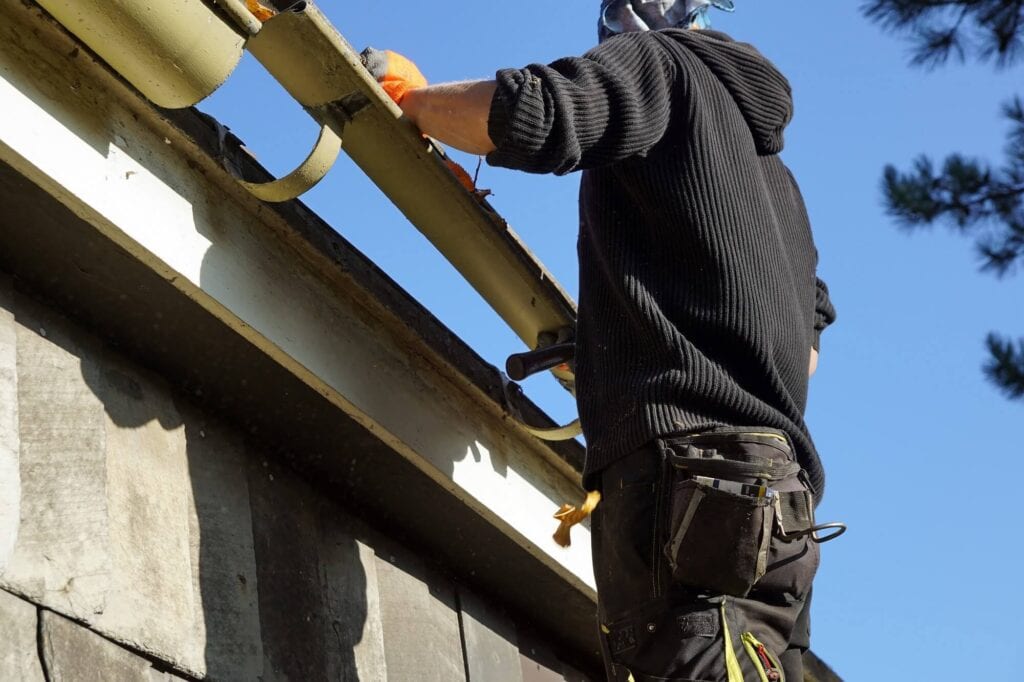
- Put the new system in place Failing sections are taken down and the roof edge is prepared before any new run is hung; the finished runs are fastened at close intervals and the joints are sealed against leaks; hangers are placed at close intervals and fastened into solid wood; work proceeds one side of the house at a time.
- Flush the system and leave the site clean Running water through every section reveals slow spots and weak joints before the crew leaves; a final walk-through covers the finished work, the cleanup and a few simple maintenance tips; a last look from the ground confirms that the runs look straight and level; the crew checks the downspout outlets one more time.
Gutters options and materials
Half-round
The open curve of this profile has no corners where leaves can lodge; hangers are visible in this style, so the choice of bracket becomes part of the look; many owners choose it when replacing original gutters on an older home.
One-piece aluminum
Rust is not a concern with aluminum, and the material accepts a long list of color choices; because each run is cut to length, the only joints are at corners and outlets; gauge and thickness vary between products, so it is worth asking which is proposed.
Box-shaped K-style runs
The K-style profile has a flat back and an ogee front, and it is the most widely used shape in residential work; size is matched to the roof area feeding each run and to the local rainfall; corner pieces and end caps are stocked in standard sizes by most suppliers.
Copper rainwater systems
As a choice, copper weathers naturally, so the look of the gutters changes gently with exposure; because the metal is a premium material, the budget conversation is part of the planning stage; brass or copper fasteners are used so the metals do not react.
Steel gutter runs
Heavy-gauge steel stands up well to snow load and hard use; the coating, not the steel itself, determines how well the system resists rust; galvanized steel suits workshops, barns and outbuildings as well as homes.
Common questions about Gutters
One-piece or sectional: what is the difference?
Sectional systems are joined every few feet, and one-piece systems are joined only at corners and outlets; sectional gutters can still be a sound choice for small jobs and repairs; both types are available in several metals and colors.
How often should gutters be cleaned?
Properties near mature trees need attention more often than those in open settings; after a major storm, a quick look from the ground can reveal problems early; a garden hose can flush a clean trough to confirm that water reaches the outlet.
Why is my gutter coming away from the roof edge?
Loose or widely spaced hangers, rotted fascia and heavy debris are the common culprits; if the run is also bent or cracked, replacing the section may be the better answer; ice in winter pulls on the hangers when the trough fills with water.
How do I choose the right gutter size?
Contractors match gutter width and downspout size to the roof area and the local rainfall; when in doubt, a wider run with an extra downspout is the safer choice; valleys concentrate water and often need a larger outlet.
Will gutter guards stop me from ever cleaning gutters?
Even with guards, an occasional look is smart, especially after heavy storms or leaf drop; the right design depends on the type of debris around the property; seasonal checks are simple when the guard lifts out easily.
Where should downspouts discharge?
The goal is to keep runoff from pooling next to the foundation; local drainage rules and neighboring property lines should be respected when choosing the location; hoses and extensions should be fastened so they do not slide back.
Areas we serve for Gutters
We provide Gutters across 27 areas.
- Annaville Texas 940-456-9905
- Argyle Texas 940-456-9905
- Azle Texas 940-456-9905
- Boyd Texas 940-456-9905
- Briar Texas 940-456-9905
- Bridgeport Texas 940-456-9905
- Decatur Texas 940-456-9905
- Haslet Texas 940-456-9905
- Justin Texas 940-456-9905
- Keller Texas 940-456-9905
- Krum Texas 940-456-9905
- Lake Worth Texas 940-456-9905
- Lakeside Texas 940-456-9905
- New Fairview Texas 940-456-9905
- Northlake Texas 940-456-9905
- Ponder Texas 940-456-9905
- Reno Texas 940-456-9905
- Rhome Texas 940-456-9905
- River Oaks Texas 940-456-9905
- Roanoke Texas 940-456-9905
- Saginaw Texas 940-456-9905
- Sansom Park Texas 940-456-9905
- Springtown Texas 940-456-9905
- Trophy Club Texas 940-456-9905
- Watauga Texas 940-456-9905
- Westworth Village Texas 940-456-9905
- White Settlement Texas 940-456-9905
Our other services
Need a second opinion?
You do not need to have the answers in advance, only the questions; J. Riley Roofing & Gutters welcomes questions at any stage of the project; concerns are easier to settle early in the planning.