As any professional roofing contractor can tell you, a roof rarely fails all at once. It fails at a two-inch rubber collar around a plumbing vent, at a single lifted ridge cap shingle, at a nail that has slowly backed out of the decking over ten summers of thermal cycling. By the time a brown ring appears on a bedroom ceiling, water has usually been moving through the attic for weeks or months soaking insulation, staining decking, and rusting the very fasteners that hold the system together. That gap between when roofing damage starts and when it becomes visible is the most expensive part of roof ownership in North Texas.
It matters right now for a specific reason: Wise County sits squarely in the hail corridor and supercells routinely track the Bridgeport-Boyd-Rhome-Decatur line from March through June, with April and May doing the most damage. Add attic temperatures that hit 130 to 160 degrees in July and August, February freeze loading that pulls gutters away from fascia, and cedar elm as well as post oak leaf drop that plugs downspouts every October which adds up to a roof that absorbs four distinct kinds of stress in a single year. A homeowner who only looks up after a leak appears is always reacting to a problem that has already grown.
This article lays out what an experienced roofing contractor actually looks for during an inspection and in the order those components tend to fail, namely pipe boots, flashing, ridge cap, fasteners, valleys and gutters plus how hail and wind damage present themselves, which interior clues deserve immediate attention, how to think through repair versus replacement, and what Texas law says about roofers and insurance claims. Property owners in Boyd Texas and nearby Springtown can use most of it from the ground, from a ladder at the eave, or from inside the attic with a flashlight.
Why Small Roofing Problems Grow So Quickly Here
Roofing materials in North Texas age faster than the average. Architectural asphalt shingles typically deliver 25 to 30 years of practical service in this climate and 3-tab shingles closer to 15 to 20, yet ventilation and hail history move those numbers more than the shingle rating on the wrapper does. The International Residential Code calls for attic ventilation at a ratio of 1 to 150, or 1 to 300 where intake and exhaust are properly balanced. Under-ventilated attics in the Boyd and Springtown Texas areas routinely run at the top of that 130 to 160 degree range, which cooks sealants, hardens neoprene, and shortens the life of everything on the deck.
The other accelerant is water volume. A single unsealed nail hole passes very little water in a light shower. The same hole under a slow, soaking rain with wind driving from the northwest can wet an area of decking several feet wide, because water follows the underside of the deck along rafters before it drips. That is why the ceiling stain is often nowhere near the actual entry point and why guessing a leak's origin from inside the house wastes time and money.
The Failure Points That Leak First
An inspection by an experienced roofing contractor follows probability, not appearance. The shingle field is usually the last thing to fail as the penetrations and transitions go first.
Plumbing Pipe Boots
Cracked pipe boots are among the most common leak sources in areas like Boyd Texas and across Wise and Parker counties. The neoprene or EPDM collar that seals around a plumbing vent stack is exposed to direct UV all day and it splits, often in a ring right at the base of the pipe, long before the surrounding shingles show any wear. From the ground with binoculars, look for a collar that appears grey, chalky, shrunken, or visibly cracked. Trade replacement pricing for a single boot that commonly runs somewhere in the $150 to $400 range, which is a fraction of what the resulting drywall and insulation repair costs.
Flashing at Chimneys, Walls, and Valleys
Step flashing tucked behind siding at a chimney or wall junction deteriorates quietly. So does the sealant on exposed fasteners at vent hoods, satellite mounts, and swamp cooler curbs. Two specific defects deserve a close look: missing kick-out flashing at the junction where the roof edge meets a vertical wall which dumps concentrated runoff straight into the wall cavity and separated valley metal, where the two halves have pulled apart and left a seam that channels water under the shingles. Neither is visible from the driveway. Both are typical of the calls a roofing contractor takes in Springtown Texas after the first heavy spring rain of the season.
Nail Pops, Lifted Ridge Cap, and Torn Sealant Strips
Decking expands and contracts every day of a Texas summer and fasteners work their way back out. A nail pop lifts a roofing shingle slightly and eventually punctures it from beneath. Ridge cap shingles sit at the highest pressure point on the roof and are usually the first to lift in a wind event. Torn sealant strips where the adhesive bead that bonds each shingle course to the one below are the invisible version of wind damage as the shingle looks fine but is no longer bonded, so the next gust drives rain straight underneath it.
Reading Hail and Wind Damage Correctly
Hail damage is genuinely difficult to see from the ground and that is not a roofing contractor sales line, it is physics. Hail around 1 to 1.25 inches typically dents soft metals first such as gutters, downspouts, vent hoods, roof jacks, and HVAC condenser fins. Asphalt shingles usually do not bruise until stones reach roughly 1.5 inches. A bruise is a soft, granule-free dark spot that gives slightly under thumb pressure, similar to a bruise on fruit. It does not leak on the day of the storm. It leaks months later, once the exposed asphalt weathers through the mat.
Wind damage reads differently. Look for creased shingles, a horizontal fold line where the shingle was bent back and dropped, plus displaced ridge cap and shingle corners that lift with almost no resistance. Wise County wind speeds are around 105 to 115 mph and high-wind installation practice uses six nails per shingle instead of the standard four. On older roofs installed to a four-nail pattern, the difference shows up in exactly these creased and lifted courses.
Metal shop buildings, barns, and detached garages on rural acreage around Boyd Texas take the same hail as the house and get inspected far less often. Fastener gaskets on exposed-fastener metal panels dry out and back out, screw holes weep, and ridge closure strips compress and fail. A thorough roofing inspection in Boyd should include those structures, not just the residence.
Interior Clues Worth Acting On Immediately
Some of the most reliable early evidence an experienced roofing contractor looks for is inside the building, where UV and rain have not had a chance to disguise it. With a flashlight and a dust mask, a property owner can check the attic in fifteen minutes and learn more than an hour of squinting at shingles would reveal.
- Dark staining or water tracks on the underside of the roof decking, especially near penetrations
- Rusted or blackened nail tips protruding through the deck, which indicates repeated condensation or leakage
- Damp, compressed, or discolored insulation, often in a narrow line following a rafter
- A musty, humid smell that persists on a dry day, signaling trapped moisture
- Daylight visible around a vent, stack, or chimney where flashing should be sealed
- Ceiling ring stains, bubbling paint, or peeling at the corner where a wall meets the ceiling
- A noticeable pile of shingle granules in the gutter trough or at the bottom of a downspout
Granules deserve a note of their own. New roofing sheds a modest amount of loose granules during the first few rains and that is normal. Heavy, ongoing granule loss on a roof that is ten or more years old, particularly concentrated on one slope, usually means the shingle surface is wearing through and UV is beginning to attack the asphalt directly.
Gutters Are Half the Drainage System
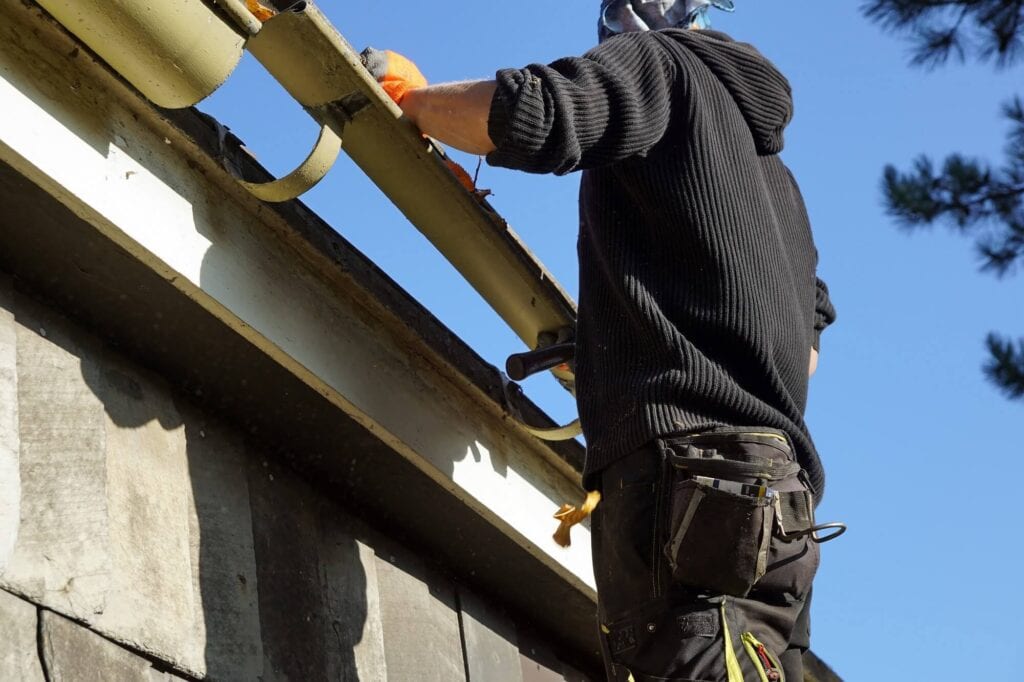
Gutters get treated as trim, but they control where thousands of gallons of water go. When the trough clogs, water backs up over the rear edge and gets behind the drip edge, the metal that code requires at eaves and rakes under IRC R905.2.8.5. From there, it wets the fascia, the decking edge, and eventually the soffit. That is a roof leak caused by the gutter and it is common in Boyd and Springtown Texas alike every autumn, once cedar elm and post oak leaves come down.
Warning signs include water sheeting over the front lip during rain, staining or streaking on the fascia, gutter sections sagging or pulling away from the fascia board, mitered corners separating, and downspouts that stay dry while the trough holds standing water. The February 2021 freeze demonstrated the other failure mode: ice loading in the trough is heavy enough to tear hangers out of fascia entirely.
For reference, market pricing for 5-inch and 6-inch K-style aluminum gutters generally falls somewhere around $6 to $14 per linear foot, with micro-mesh guards typically running $8 to $25 per linear foot. Guards reduce clogging substantially, but they do not prevent leaks on their own as they do nothing for a cracked boot or failed flashing.
A Practical Inspection Cadence
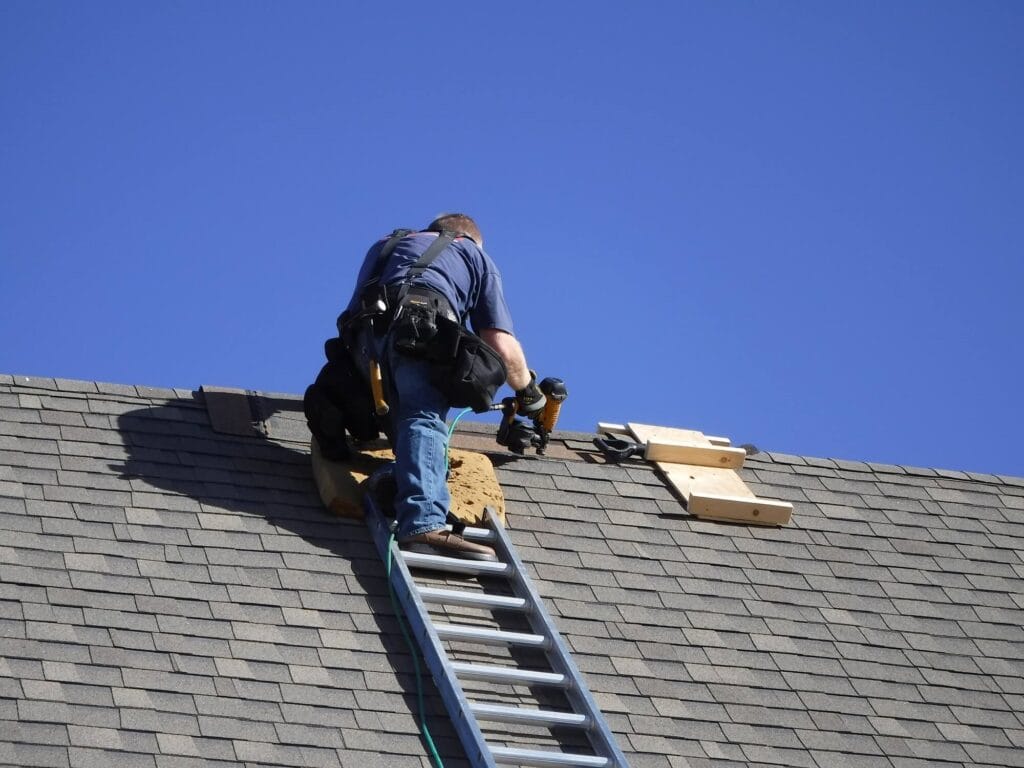
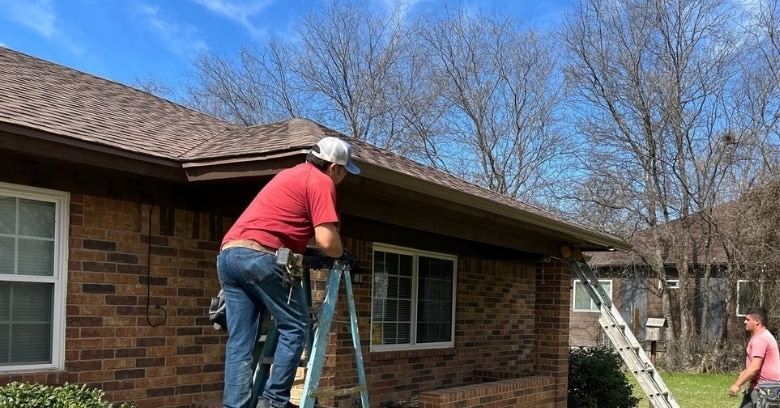
According to most roofing contractors, twice a year plus after any storm producing 1-inch or larger hail or wind gusts near 58 mph is a reasonable standard to inspect roofs for this region. A repeatable routine looks like this:
- Walk the full perimeter of the building with binoculars and photograph each slope, noting lifted, creased, or missing shingles and the condition of every visible pipe boot.
- Check soft metals up close including gutters, downspouts, vent hoods, window wraps, and the HVAC condenser since dents there are the first confirmation that hail was large enough to matter.
- Clear gutters and downspouts, then run a hose and confirm water exits at grade rather than pooling against the foundation.
- Enter the attic with a flashlight and inspect decking, nail tips, insulation, and the area around every penetration and chimney.
- Photograph interior ceilings and wall corners on the top floor, dating the images so slow-growing stains can be compared over time.
- Keep a simple file of storm dates, photos, and any repair invoices, which makes future conversations with a roofing contractor or a carrier far easier.
- Schedule a professional evaluation any time step one or step two turns up something ambiguous.
Repair or Replace: A Framework, Not a Guess
The decision to repair or replace usually turns on four questions: how old the roof is relative to its expected life, whether damage is isolated or distributed across multiple slopes, whether matching material is still available, and whether the decking beneath is sound. Isolated damage on a roof with a decade of serviceable life remaining is a repair. Distributed hail bruising on a twenty-year-old 3-tab roof with brittle shingles is a replacement, because every repair attempt cracks the surrounding field.
For scale, regional trade figures indicate that asphalt roofing replacement costs range from approximately $400 to $700 per square or about $4.50 to $8.00 per square foot installed, with full replacements commonly landing between $9,000 and $25,000 or more depending on size, pitch, and material. Targeted repairs are far less expensive as small leak repairs typically run $400 to $1,500 and ridge cap or valley work often $500 to $2,000. These are market ranges for the broader DFW area, not quotes, and any qualified roofing contractor should walk the roof before quoting.
One credential note that matters locally: Texas does not issue a state roofing contractor license. Verifiable credentials come from manufacturers and voluntary trade associations instead, so property owners comparing bids should ask about manufacturer certification, insurance coverage, local references, and workmanship terms in writing rather than assuming a state license exists. It is worth asking a roofing contractor in Springtown Texas or anywhere in Wise County to document those items on the proposal itself.
Where Insurance Fits and Where It Does Not
Most homeowner policies require prompt notice of a loss, so delay works against the property owner. The more consequential detail is the endorsement language as many carriers now attach cosmetic-damage exclusions or actual cash value roof endorsements that can dramatically change a payout. Understanding whether a policy pays actual cash value which deducts depreciation, or replacement cost value which does not is the single most useful thing an owner can learn before a storm, not after one.
Texas law draws firm lines here. Insurance Code Section 707.003 prohibits a contractor from paying, waiving, absorbing, or rebating an insurance deductible and Chapter 4102 prohibits roofers from acting as public adjusters or negotiating a claim on a policyholder's behalf. A legitimate roofing contractor in Boyd Texas documents damage, provides a detailed scope and pricing, and meets an adjuster on site while the policyholder handles the claim itself. Anyone offering to make a deductible disappear is describing an illegal transaction and that alone is reason enough to walk away.
Permitting is worth a phone call, too. Unincorporated Wise County generally does not require residential building permits, while the City of Boyd may have its own requirements, so verifying jurisdiction before work begins avoids problems at resale. A local roofing contractor working in Boyd or Springtown regularly will know which questions to ask and where.
Conclusion
Roofing problems in this part of North Texas rarely announce themselves on the day they begin by starting as a split pipe boot, a creased shingle, or a clogged downspout and quietly compound through a season of 100-degree afternoons and spring hail. The property owners who spend the least on their roofs over a lifetime are the ones who look twice a year, look again after every serious storm, photograph what they find, and call a professional while the problem is still measured in inches rather than rooms.
Anyone who has noticed granules in the gutter, a stain spreading on a ceiling, or dented gutters after the last hail event should schedule an evaluation with a reliable local roofing contractor now rather than waiting for the next round of storms in April and May. Acting early preserves options: a repair stays a repair, a claim stays within the notice window, and interior finishes stay dry!
Key Takeaways
- Cracked plumbing pipe boots, deteriorated step flashing, missing kick-out flashing, separated valley metal, and lifted ridge cap cause more leaks than worn-out shingle fields do.
- Hail bruising is often invisible from the ground, so check soft metals like gutters, downspouts, and vent hoods first as dents there confirm the stones were large enough to matter.
- Inspect twice a year and again after any storm with 1-inch or larger hail or gusts near 58 mph, since damage can take months to produce a visible leak.
- A fifteen-minute attic check with a flashlight reveals decking stains, rusted nail tips, and damp insulation long before a ceiling ring appears downstairs.
- Clogged gutters push water behind the drip edge and rot fascia and decking edges, which makes gutter maintenance a genuine leak-prevention task.
- Texas issues no state roofing license and prohibits contractors from waiving deductibles or negotiating claims, so verify manufacturer certification, insurance, and written workmanship terms instead.
Frequently Asked Questions
Can hail damage really be invisible from the ground?
Yes - asphalt shingle bruising is frequently impossible to identify from ground level. A hail bruise is a soft, granule-free dark spot that reveals itself by feel and close inspection, not by silhouette, which is why dented gutters, downspouts, vent hoods, and HVAC fins are used as corroborating evidence that the storm carried stones large enough to damage the roof.
Will filing a claim raise my premium or get me non-renewed?
That depends entirely on the carrier, the policy, and the claim history, and no contractor can answer it for a specific policy. The reliable approach is to have the roof evaluated first, learn whether the damage is genuinely storm-related and how extensive it is, then discuss the coverage question directly with the insurance agent before deciding.
How long do I have to file after a storm?
Most homeowner policies require prompt notice of a loss and while many carriers allow a period measured in months or a year, waiting weakens the claim because later storms make it harder to establish which event caused the damage. Documenting the date, photographing damage, and notifying the carrier quickly is always the stronger position.
How do I decide between repairing and replacing?
Repair when damage is isolated and the roof still has meaningful serviceable life left; replace when damage is spread across multiple slopes, the shingles have become brittle, or the decking is compromised. Roof age, material availability for matching, and the condition of the deck beneath are the deciding factors and all three require someone on the roof to assess accurately.
Is my roof still under manufacturer coverage if a previous owner installed it?
Sometimes, but transferability varies by manufacturer and by warranty tier& and many require a formal transfer within a set window after the sale. Locating the original installation paperwork or product documentation is the first step, since the shingle line and installation date determine what coverage, if any, still applies.
Do gutter guards actually stop roof leaks?
Gutter guards prevent one specific type of leak, the kind caused by a clogged trough backing water up behind the drip edge, but they do nothing for cracked pipe boots, failed flashing, or storm damage. They are a maintenance improvement rather than a waterproofing solution and micro-mesh products still need occasional cleaning of the mesh surface.
Can you inspect without walking on my shingles?
In many cases, yes inspections can be performed from a ladder at the eave, with binoculars and long-lens photography, and increasingly with drone imagery, which is often the right choice on brittle, older, or specialty roofing. That said, confirming hail bruising usually requires hands-on contact with the shingle surface, so a physical inspection may still be recommended.
What is the difference between ACV and replacement cost?
Actual cash value pays the depreciated value of the roof at the time of loss, while replacement cost value pays what it costs to replace it, typically with depreciation released after work is completed. Many carriers have added actual cash value or cosmetic-damage roof endorsements in recent years, so reading the endorsement pages before a storm is well worth the time.
Why is my ceiling stain nowhere near the roof leak?
Water entering the roof runs along the underside of the decking and follows rafters, trusses, and wiring before it finally drips so that the interior stain can sit many feet away from the actual entry point. That is exactly why attic inspection matters as tracing the water path upward from the stain is the only reliable way to find the true source.